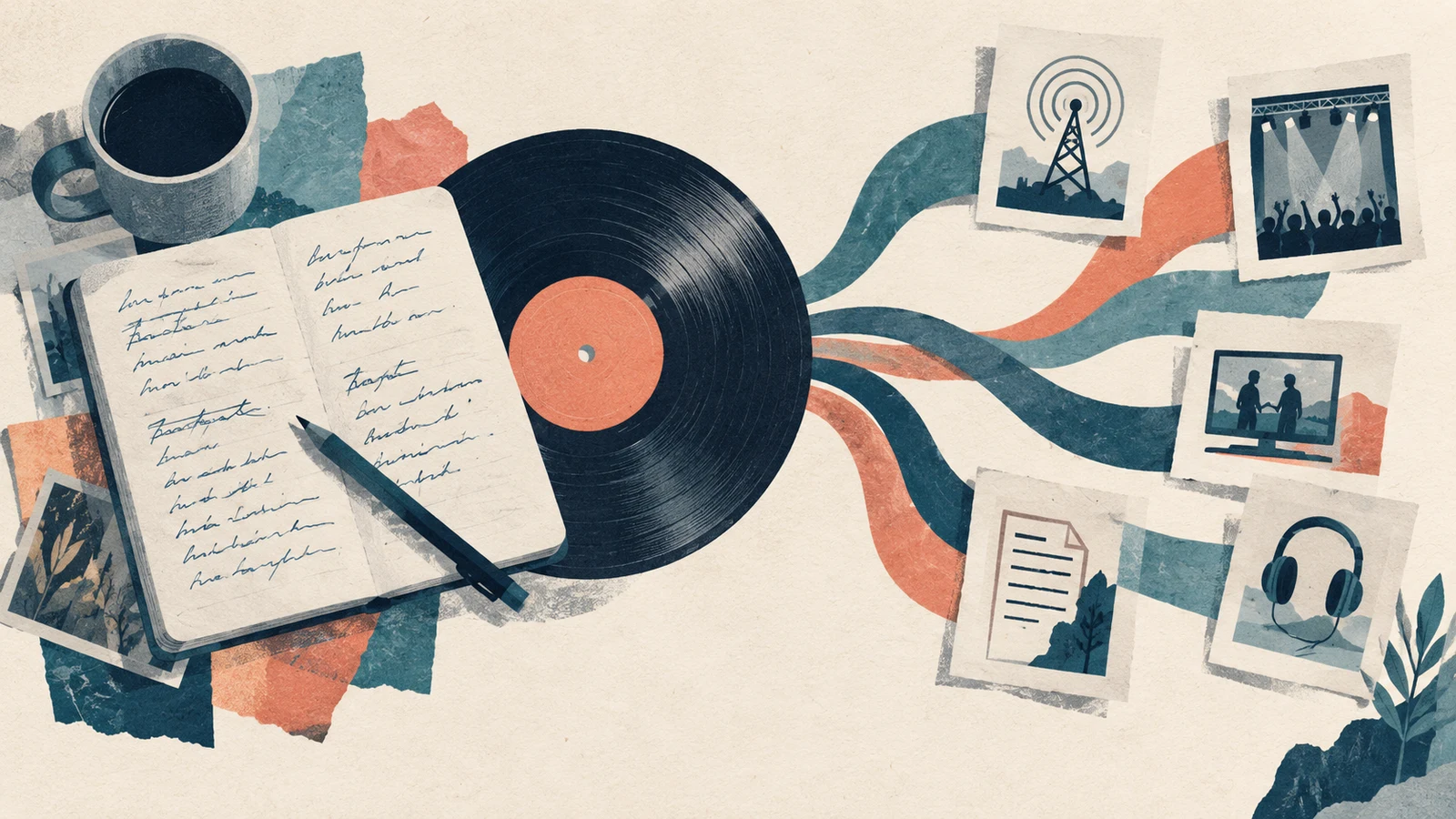
Music publishing royalties start with the song, not the audio file
Music publishing royalties concern the underlying composition: the music and lyrics. Recording income concerns a particular recorded performance of that composition. You might control both, one, or neither. Knowing which rights you control is the first step toward understanding a royalty statement.
For a songwriter, the main categories to understand are public performance royalties, mechanical royalties, and synchronization licensing income. They arise from different uses and do not necessarily arrive through the same organization.
This guide uses the United States as its reference point. Collection systems, contracts, and rules differ by territory, so use it as an orientation rather than a determination of what a particular song will earn.
Separate the composition from the recording
The U.S. Copyright Office's guide to compositions and recordings describes them as separate works. A song can have several recordings while remaining the same underlying composition.
Imagine two writers create a song, then a singer records it. The writers' interests in the composition and the ownership of that recording are separate questions. If a different artist later records a cover, that creates another recording; it does not automatically make the cover artist a writer of the original composition.
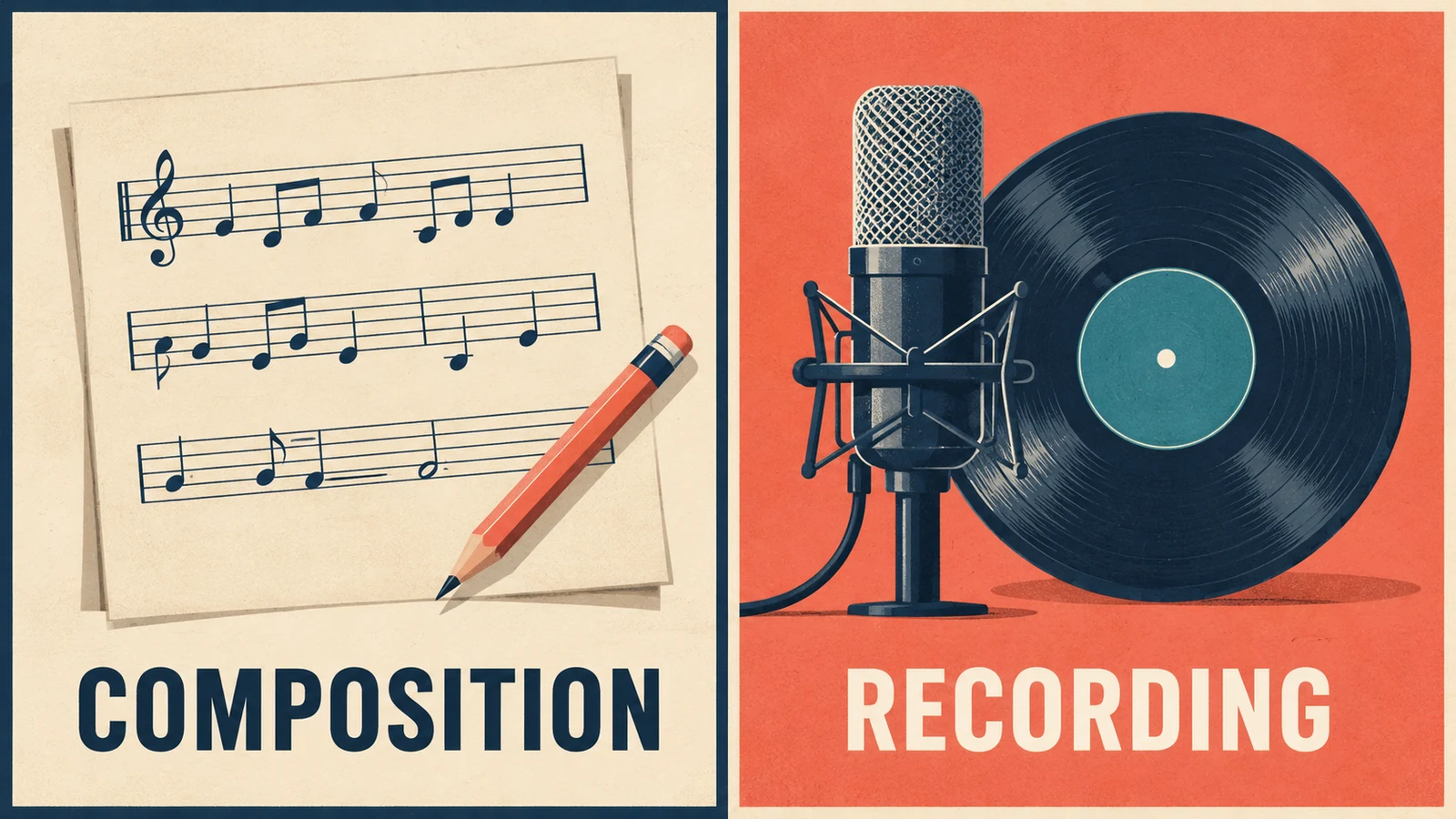
| Question | Composition side | Recording side |
|---|---|---|
| What is being tracked? | The underlying music and lyrics | A specific recorded performance |
| Who might control it? | Writers, publishers, or their authorized representatives | An artist, label, or other recording owner |
| What information helps identify it? | Work title, writers, agreed shares, publishing details | Recording title, artist, version, recording identifier |
| Does controlling one establish control of the other? | No | No |
Avoid using “I own the song” as a substitute for these details. Before registering or licensing anything, describe exactly what you wrote, what you recorded, and what an agreement assigns or administers.
1. Public performance royalties: when a composition is performed
Public performance royalties can arise when a composition is used in licensed performances, including broadcasts, live venues, and digital services. In the U.S., performing rights organizations, or PROs, administer this category for the works they represent.
BMI explains that it collects license fees and distributes performance royalties to affiliated writers and publishers. Its role does not mean it handles every right in a song. BMI's licensing FAQ explicitly distinguishes performing rights from mechanical and synchronization rights.
For your own catalog, check whether the work is registered correctly and whether a publisher or administrator already handles the relevant shares. A stage name on a streaming release is not a complete record of the writers and their publishing interests.
Do not estimate your payout from a single generic “per play” figure. The applicable licensing and distribution rules matter, as do the reported uses and the shares you are entitled to receive.
2. Mechanical royalties: reproduction and eligible digital uses
Mechanical royalties relate to reproductions of a musical work. The word “mechanical” predates streaming, but the category still matters for digital music.
In the United States, The Mechanical Licensing Collective administers blanket mechanical licenses for eligible streaming and download services. It collects royalties under those licenses and pays the appropriate musical-work rightsholders, including publishers and self-administered songwriters.
That is a specific role. The MLC is not a universal collector for every music payment, every territory, or every kind of use. Its work should not be confused with payment for ownership of a sound recording.
The MLC's explanation of mechanical payments describes matching service usage data to musical works before distribution. For creators, this makes accurate identification practical work, not just paperwork: a recording's title, writer information, and work registration need to connect properly.
If you have a publishing administrator, establish who is registering and collecting your share before creating overlapping claims. If you administer your own work, check The MLC's membership guidance for the rights you actually control.
3. Synchronization: permission to pair a composition with pictures
Synchronization, usually shortened to “sync,” concerns using a composition with moving images, such as in a film or advertisement. BMI's rights overview describes synchronization licenses as issued by publishers acting as copyright owners or agents.
Sync income is often discussed alongside publishing royalties, but a negotiated license fee is not necessarily a recurring royalty. The agreement defines the permitted use and payment terms. There is no universal fee that applies to every placement.
Using an existing recording also raises a separate master-use permission question. A producer should establish who can license the composition and who can authorize that recording. One person may control both, but that must be confirmed rather than assumed.
For a hypothetical short advertisement, an inquiry should identify the exact track, the portion requested, where the ad will appear, the territory, and the proposed term. Those facts help the rightsholders evaluate the request. They do not themselves grant permission.
If you are choosing music for a video rather than collecting income from your own work, start with our guide to checking a song's copyright and permission trail.
Recording royalties are a separate part of the picture
A recording can generate income alongside publishing income. The organizations and contracts involved depend on the use.
For example, SoundExchange's FAQ describes its collection and distribution of royalties for featured artists and sound-recording copyright owners from non-interactive digital sources. This is the recording side, not the same function as a PRO's composition performance royalties or The MLC's digital mechanical collection.
“Non-interactive” is an important boundary here. Do not assume every on-demand stream or every payment appearing in a distributor dashboard follows the SoundExchange route.
A useful question to ask any distributor or administrator is: Which rights, uses, and territories does this agreement cover? Follow it with: Which remain my responsibility? The answers are more useful than a promise to collect “all royalties” without a defined scope.
Keep three sets of records before release

Create a small rights folder for each work. You can begin with a spreadsheet and copies of the relevant agreements; the important part is consistency.
- Writers: list the work title, each writer's name, agreed composition shares, publishing or administration contacts, and applicable work identifiers.
- Recordings: list each version, featured artist, recording owner, release information, and recording identifier where assigned.
- Agreements: retain collaborator agreements, administration arrangements, licenses, and documentation showing what you are authorized to claim.
For example, “Night Bus” might have an acoustic recording and an electronic recording. Keep both connected to the correct composition record, while preserving their different recording details. This is an illustrative filing example, not a claim that either version will generate income.
When a statement seems incomplete, first identify the payment category and reporting period. Then compare the work and recording information with the records held by the relevant service. A missing payment should lead to a specific inquiry, not an immediate duplicate registration everywhere.
AI music: commercial permission is not automatic royalty eligibility
If you use AISongsGenerator or another creation tool, keep the generation history and your own contributions alongside the rights folder. Review the applicable service terms before release. A permission to use an output commercially does not, by itself, settle copyright ownership or eligibility for a collecting organization's distributions.
The U.S. Copyright Office's report announcement on AI outputs emphasizes human authorship and sufficient human-determined expressive elements. An AI-assisted work and an entirely machine-generated output should not be treated as identical simply because both were made with software.
Record original lyrics, melodies, performances, and creative edits accurately. Do not claim authorship of elements you did not create, or assume that uploading a generated file guarantees publishing income. For a disputed ownership question or a significant licensing deal, get advice specific to the work and jurisdiction.
Questions about music publishing royalties
Does a distributor collect publishing royalties automatically?
Check the agreement. Distribution and publishing administration are different functions, even when a company offers both. Confirm the particular service you enrolled in and which rights it administers.
Are sync fees the same as performance royalties?
No. A sync agreement authorizes a specified audiovisual use, while performance royalties concern a different right. A placement can involve more than one payment category, depending on its use and the relevant arrangements.
Does “royalty-free” mean a composition has no owner?
No. It describes licensing terms, not the absence of copyright. Read the license attached to the track. Our royalty-free music source guide focuses on those practical selection checks.
Follow the right and the use before following the payment
To make sense of music publishing royalties, identify the composition, the recording, the use, and the party authorized to collect. Keep those four details connected in your records. You will then be able to ask the right organization about a specific payment instead of expecting one registration to cover every possible income stream.