Write meditation music prompts around the sound you need
Useful meditation music prompts describe the arrangement: which instruments are present, how busy they are, whether speech needs room, and how the cue should finish. “Relaxing music” alone leaves all of those choices open.
Start with one of the original prompts below and change only the details relevant to your project. They are creative starting points, not tested presets or promises of a particular emotional or health outcome. A generator may interpret the same description differently from one attempt to the next.
For a guided recording, prioritize the voice. For an instrumental listening session, you may want more melodic detail. Decide which job the music has before adding more adjectives.
Set the instrumental option and keep the brief consistent
In AISongsGenerator's music generator, turn on Instrumental when you want music without singing. Describe the intended instrumentation and arrangement in the prompt. Check the full result afterward; a written instruction is not proof that the audio contains no voice-like fragments.
This general approach is also reflected in Suno's instrumental guidance, which recommends describing style, mood, instruments, tempo, or energy and using its instrumental option. Controls differ between tools, so use the settings actually available in your chosen interface.
A compact brief can follow this pattern:
Instrumental [musical style] with [main sound] and [supporting sound].
[Amount of movement and space].
[Opening and ending behavior].
No [specific unwanted element].
Avoid asking for a sparse, nearly motionless cue and an energetic percussion build in the same version. If both are needed, make separate cues or clearly distinguish the sections.
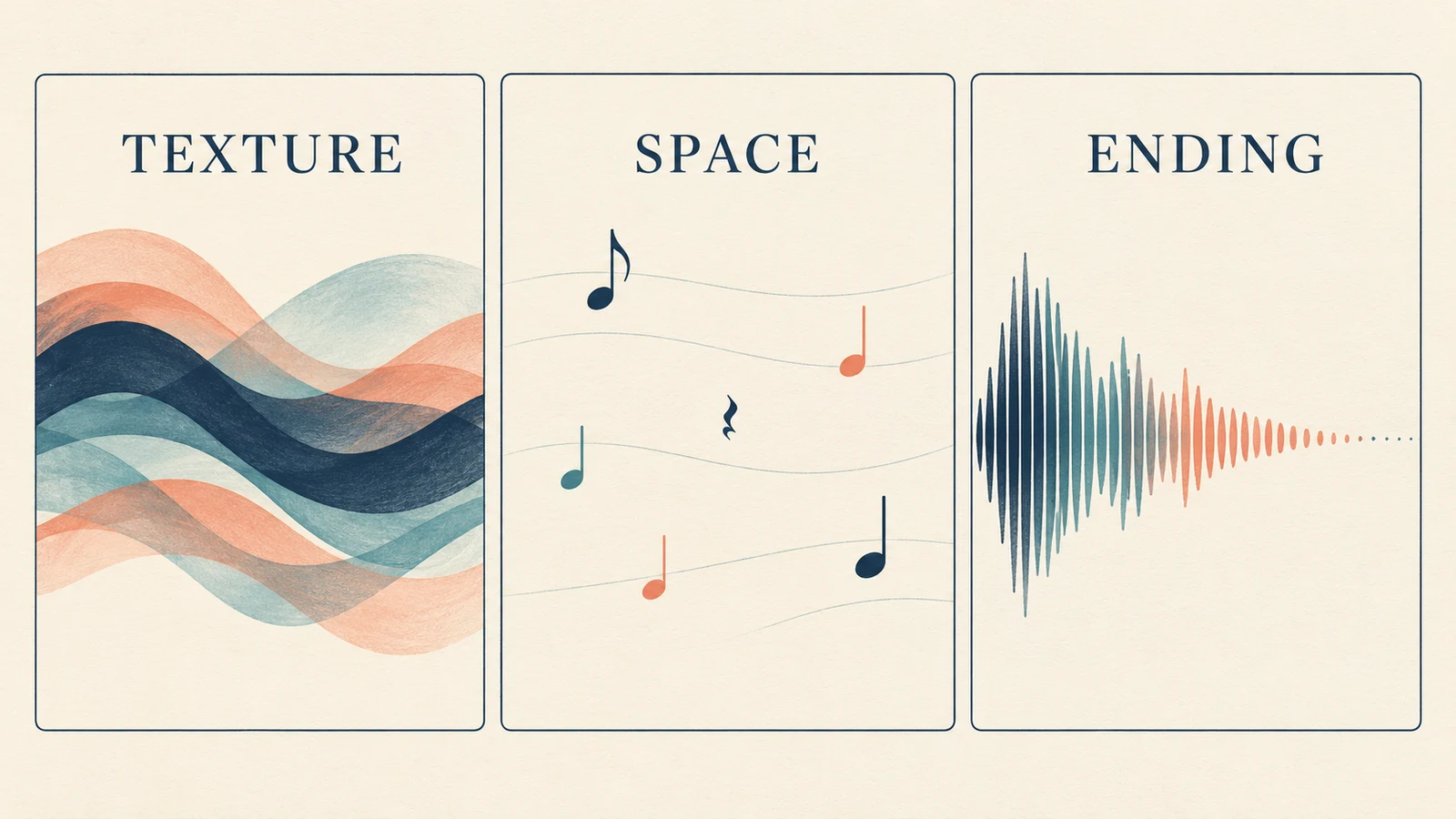
Ten original AI meditation music prompts to adapt
1. Sparse piano for a spoken introduction
Instrumental background for a softly spoken introduction. Warm piano chords with long gaps, a faint sustained pad, and minimal melodic movement. Gentle entrance and a gradual fade. No vocals, percussion, dramatic swell, or bright high-note runs.
Use this when the spoken message should remain the main event. If the piano becomes a solo, request fewer notes rather than adding another instrument.
2. A sustained ambient bed without a beat
Instrumental ambient bed built from soft, slowly evolving synthesizer tones. No clear drum pulse, no lead melody, and very gradual changes in color. Keep the texture even from the opening through a quiet ending. No voices or sudden transitions.
This is a starting point for a continuous background. Listen for large changes that the phrase “slowly evolving” might still produce.
3. Warm acoustic guitar with space between phrases
Gentle instrumental acoustic guitar, softly fingerpicked with short phrases and generous pauses. A restrained low sustained layer supports the guitar. Keep the arrangement intimate and unhurried. No singing, busy strumming, sharp percussion, or climactic build.
If the picking pattern feels too prominent, simplify the guitar part before changing the entire style.
4. Bell-like tones with softened attacks
Sparse instrumental bell-like tones over a warm ambient pad. Rounded, soft attacks, long decays, and plenty of space between notes. Avoid piercing high frequencies, rapid arpeggios, vocals, and abrupt accents. End by letting the texture fade gently.
Audition the attacks carefully. A pleasant sustained tone can still begin with a sharp hit that does not suit the recording.
5. Low-register strings for a restrained atmosphere
Instrumental ambient strings centered on warm low and middle registers. Long held notes, slow chord changes, and a small ensemble feel. No soaring solo violin, dramatic crescendo, drums, or voices. Maintain an understated texture and a soft ending.
Choose this for a fuller sound than solo piano. Reduce the number of layers if the result feels cinematic rather than unobtrusive.
6. A light pulse without a prominent drum kit
Instrumental background with a very gentle, steady pulse, soft hand percussion, and warm sustained keyboard chords. Keep the rhythm understated and the melody sparse. No forceful kick drum, busy fills, vocals, or sudden changes in intensity.
The pulse is a musical preference, not a breathing prescription. If timing must follow a spoken exercise exactly, align it in an editor afterward.
7. A minimal electronic texture beneath narration
Quiet instrumental electronic bed for continuous narration. Soft rounded synth tones, minimal bass movement, no lead instrument, and consistent intensity. Leave the arrangement sparse throughout. No speech samples, singing, risers, drops, or strong rhythmic hooks.
Test it with the actual voice recording. A track that sounds restrained alone can still compete with speech.
8. A brighter cue for an opening segment
Gentle instrumental opening with warm electric piano and a few light plucked notes. A clear but restrained melodic phrase, followed by a simpler sustained texture. No percussion build, vocals, sharp accents, or abrupt stop. Keep the overall mood light and spacious.
Use the melodic phrase to establish the opening, then select a quieter passage when the narration begins.
9. A stable passage intended for later looping
Instrumental ambient texture with consistent instrumentation and very little harmonic movement. No distinct introduction, final flourish, lead solo, percussion fill, or vocals. Keep the middle section stable so it can be reviewed and edited into a repeating background.
This requests loop-friendly material; it does not guarantee a seamless loop. Inspect and listen across the join after editing.
10. A closing cue with a complete decay
Short instrumental closing cue with a few soft piano notes and a warm sustained chord. Let the arrangement gradually become simpler, then allow the final sound to decay. No final drum hit, vocal phrase, sudden swell, or sharply cut ending.
Reserve space for the decay in the final timeline. A prompt cannot guarantee that the last audible sound lands on an exact frame.
Revise the problem you actually hear
Before regenerating, write one sentence about what is wrong. “Too busy under the voice” gives you a more useful next step than “not relaxing enough.”
| What you hear | Focus the next revision on |
|---|---|
| The melody competes with narration | Fewer notes and less prominent lead instrumentation |
| The music suddenly becomes much fuller | More consistent intensity and fewer arrangement changes |
| Percussion attracts too much attention | Remove fills, reduce the pulse, or try no percussion |
| The ending cuts off | A quieter closing passage and room for the decay |
| A voice-like sound appears | Recheck Instrumental and request no vocals or speech samples |
Keep the rest of the brief stable while changing one feature. That makes it easier to understand whether the revision addressed the problem. Save promising versions instead of assuming the next generation will preserve everything you liked.
Finish the audio before using it in a session or video
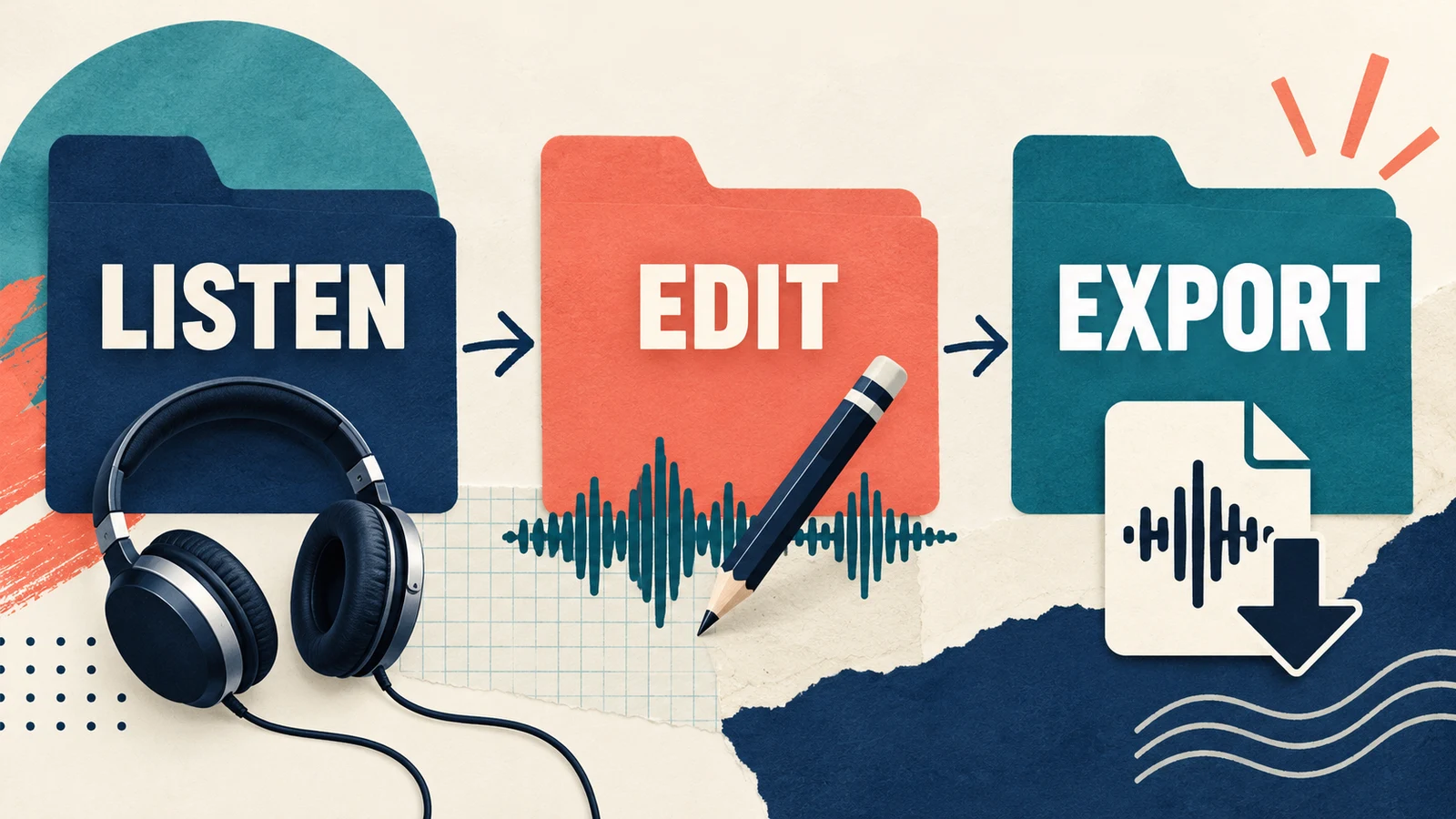
Listen to the complete cue, including passages you will later place under speech. Check for unexpected accents, changes in level, voice fragments, and an ending that feels unfinished. Then listen again with the narration at the intended playback level.
If you repeat a passage, review the boundary several times. A crossfade overlaps the outgoing and incoming audio while their levels change; Audacity's crossfade guide explains ways to make that transition. It can soften an edit, but cannot make incompatible musical passages fit automatically.
For a fixed-length recording, use the timeline as the timing authority. Our music-to-video length guide covers trimming, repeating, and adjusting a cue. Keep an untouched export so you can revise the edit without losing the original.
Check current download and plan conditions before planning a delivery. If you intend to publish the music or use it in a client project, retain the relevant permissions and terms with the files. The words in your prompt do not determine the output's usage rights.
Questions about meditation music prompts
Can I request an exact frequency such as 432 Hz?
You can write it in a prompt, but do not treat the text as proof of the resulting tuning or signal frequency. A precise technical specification needs an appropriate audio workflow and verification. These prompts make no claim about therapeutic frequencies.
Will asking for ten minutes produce exactly ten minutes?
Do not assume so. Generation duration depends on the tool and its controls. Measure the exported file, then edit the arrangement to the length your project requires.
Should I add rain or ocean sounds to every prompt?
Only if those sounds suit the brief. Try the instrumental on its own first. An additional texture can become distracting or make edits more noticeable, so review it as a creative choice rather than a required ingredient.
Start with a clear texture and finish with careful listening
The most useful meditation music prompts describe a manageable arrangement and a real use case. Choose one starting point, revise the specific issue you hear, and check the full exported audio. A restrained prompt plus a careful edit is a more workable process than stacking vague promises of calm into a long description.