
Lo-fi music for studying is an option, not a performance guarantee
Lo-fi music for studying can be a background you enjoy, but enjoying a playlist is not proof that you are learning more. The useful question is whether you complete your actual task accurately while it plays. Sometimes the answer may be yes; sometimes turning it off is the simpler choice.
Start with a quiet instrumental selection, compare it with silence, and check your work rather than relying only on how focused you feel. You do not need to find a scientifically perfect playlist before opening your textbook.
This guide offers a practical listening experiment and creative prompts for background music. It does not claim a particular tempo, texture, or genre improves grades, treats attention difficulties, or works for everyone.
What one direct study of lo-fi actually found
A 2023 study by Souza and Barbosa in the Journal of Cognition compared silence, instrumental hip-hop lo-fi, and music with lyrics across memory, reading, and arithmetic tasks in college students. The instrumental condition did not produce a credible improvement or impairment in performance. Lyrics were generally more disruptive, while participants sometimes perceived instrumental music as beneficial.
That distinction matters: subjective preference and measured performance are separate outcomes. The researchers also noted that their study was not powered to establish very small instrumental-music effects. It does not prove that lo-fi always helps, always harms, or is equivalent to silence in every setting.
Treat the finding as a reason to check your own workflow, not as a prescription. A short laboratory task is not an entire semester, and one selection of music cannot represent every playlist carrying the lo-fi label.
Choose the task before choosing the soundtrack
Define what the next study block requires. Reading a new argument, memorizing unfamiliar words, formatting notes, and checking calculations are different jobs. Avoid treating “studying” as one activity with a single ideal sound.
The following are practical starting choices to compare, not a ranking established by research:
| What you are doing | First comparison to try | What to observe |
|---|---|---|
| Reading unfamiliar material | Silence versus quiet instrumental music | Whether you can explain the main argument afterward |
| Memorizing terms | Silence versus the same short instrumental selection | Recall after putting the material away |
| Solving problems | Keep the task difficulty similar across conditions | Correct answers and repeated mistakes |
| Organizing existing notes | Your usual setup versus a restrained playlist | Finished work and unnecessary interruptions |
If you repeatedly stop to identify a sample, sing along, or change tracks, the soundtrack has become another task. Choose a less engaging selection or remove it for that block.
Compare music and silence without turning it into a project
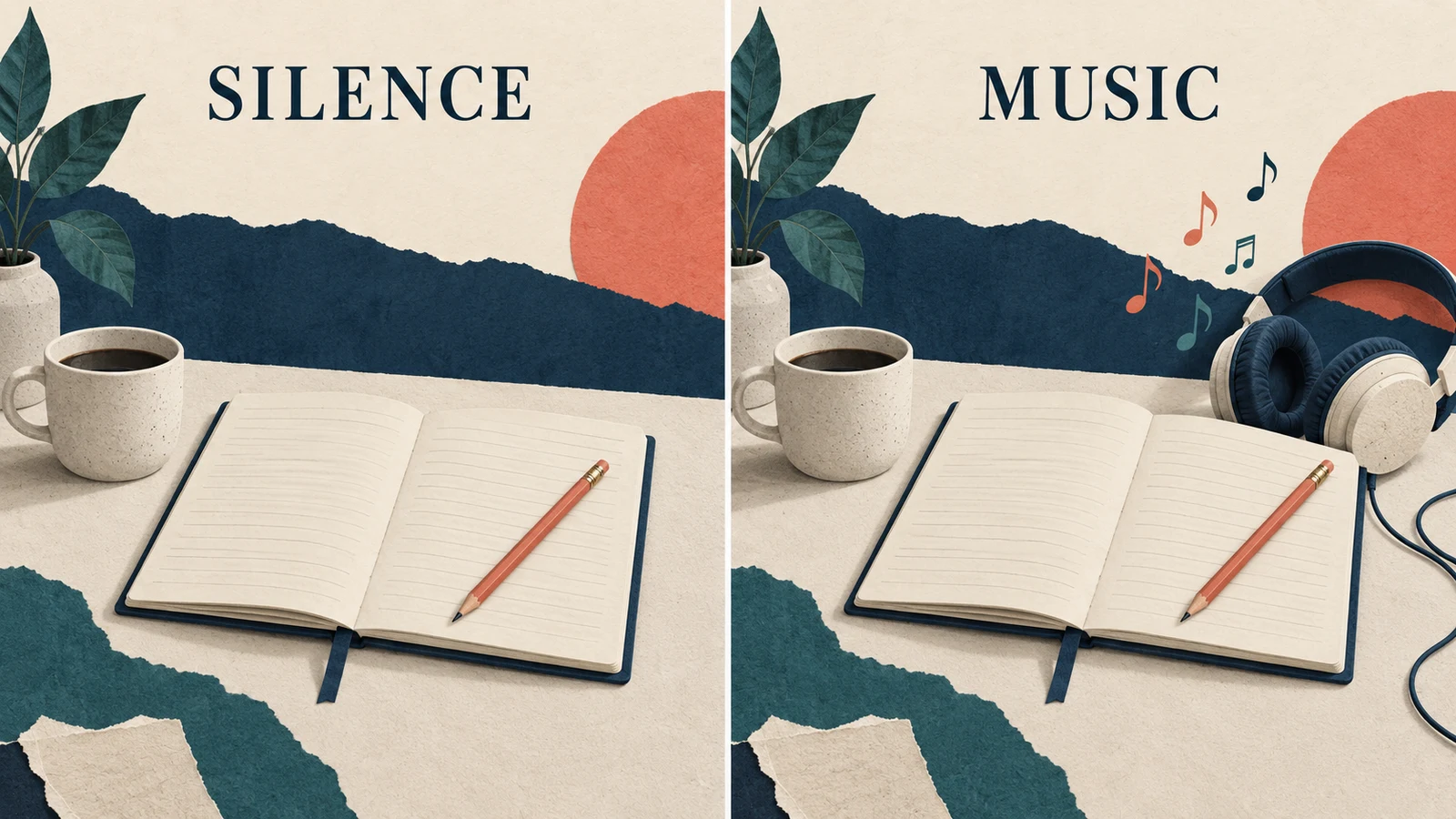
Use a modest comparison you can repeat. The aim is to notice a useful pattern, not to claim a scientific result from two study sessions.
- Pick two similar sets of work, such as practice questions on the same topic. Avoid comparing an easy review page with a completely unfamiliar chapter.
- Use silence for one block and the same instrumental playlist for the other. Keep the block lengths and surroundings as similar as practical.
- Choose the audio before starting. Do not spend the music block browsing recommendations.
- Check the work after each block. Record completed questions and errors, or write a short summary without looking at the source.
- Repeat on another day with the order reversed. Fatigue, practice, and task differences can otherwise explain what looked like a music effect.
Use a simple record:
| Condition | Work completed | Errors or missed ideas | How it felt |
|---|---|---|---|
| Silence | Your observation | Your observation | Your observation |
| Instrumental music | Your observation | Your observation | Your observation |
Keep the last column separate from the others. You may prefer music even when the work looks similar. That can inform a personal routine without becoming a claim that the music improves learning.
Select a background you will not keep adjusting
Listen to a candidate track before using it under demanding work. Check the opening, a middle section, and the ending. A calm introduction can lead into a prominent vocal sample or a sudden change later.
For a first comparison, try these creative constraints:
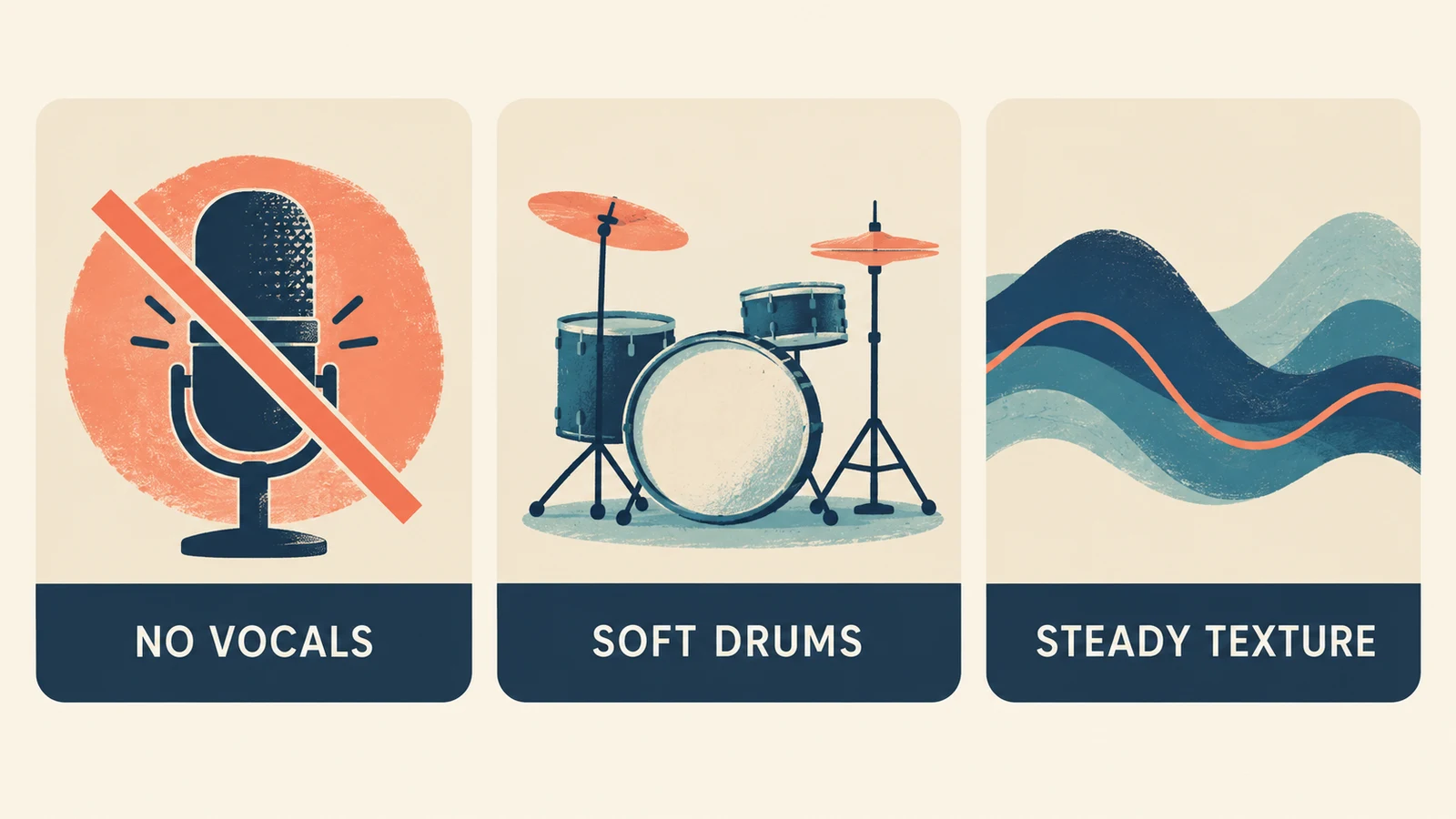
- No sung lyrics or spoken samples.
- A consistent arrangement without dramatic drops or long solos.
- A comfortable, unobtrusive listening level.
- A playlist or file you can leave alone for the whole block.
These are selection preferences intended to reduce reasons to interact with the music. They are not proven cognitive settings. Vinyl noise, rain sounds, and soft percussion are optional; if a crackle or repeating sound keeps catching your attention, remove it.
You also do not need to match a claimed “focus frequency” or an exact beats-per-minute target. Start with a sound you find easy to leave in the background, then judge the completed work.
Create a lo-fi instrumental brief with AI
If you want to explore your own sound, AISongsGenerator's music generator includes an Instrumental option. Use it alongside a specific musical description. A request for “study music” alone leaves many choices open.
Try this original prompt:
Instrumental lo-fi hip-hop with warm electric piano, soft brushed drums, a simple bass line, and a steady, understated arrangement. No singing, spoken samples, dramatic drops, or prominent solo. Keep the texture gentle and consistent.
For a less rhythmic variation:
Quiet instrumental background with sparse piano chords and a soft sustained texture. Minimal percussion, no vocals or speech, no sudden transitions, and a restrained melody.
These prompts describe an intended sound, not a tested study aid. Listen to the entire output before adding it to your routine. An instrumental instruction should still be checked for unwanted voice-like fragments or attention-grabbing changes.
Change one musical feature at a time. If the drums dominate, request less percussion. If the melody keeps pulling you away from the page, ask for a sparser line. If you would rather explore styles than adjust individual instruments, our music genres guide can help you describe the direction.
Generation is also separate from exporting. Review the current download and plan conditions before expecting to save a file. Do not assume that a generated track is a seamless loop; audition the join if you repeat it.
Know when to switch the music off
Use observable signals. If you lose your place repeatedly, cannot summarize what you just read, or keep reaching for the player, try the next block without music. You do not have to finish a playlist to make the comparison fair.
Likewise, keep music if it fits the routine you prefer and your work checks out. The decision can differ between tasks or days. A quiet session is not a failure of the playlist, and a pleasant session is not proof of better retention.
Keep the experiment secondary to the work. A useful study session should not depend on spending half an hour finding the perfect background.
Questions about lo-fi study music
Is lo-fi better than classical music for studying?
This guide does not establish a winner between genres. Compare the actual tracks and the task. A restrained selection in one genre may be easier for you to ignore than a dramatic piece in another.
Does instrumental mean distraction-free?
No. A solo, rhythmic change, or familiar melody may still draw your attention. Removing lyrics is one possible starting choice, not a guarantee.
Should I use the same playlist every time?
Use a stable selection while comparing conditions so that you change fewer things at once. Afterward, choose what fits your routine. Stop or change it if you spend more time attending to the music than the work.
Let the work decide whether the music stays
Choose lo-fi music for studying because it suits your routine, not because a playlist title promises better grades. Start simply, compare with silence, and check accuracy or recall. If you make your own background track, describe the musical features clearly and review the result before using it.