Pop, rock, hip-hop, dance and R&B are useful starting points when exploring popular music genres. Choosing a style for your own song takes one more step: describe the rhythm, instruments and vocal delivery you want to hear. “Pop” alone leaves room for everything from a quiet piano song to a bright electronic chorus.
This guide separates two questions: what a published popularity survey tells you, and how to turn a genre label into a workable musical brief. The prompts below are original writing examples, not tested audio results or guaranteed recipes.
Which music genres are most popular?
In IFPI's Engaging with Music 2023 survey, the leading favorite categories were pop, rock, hip-hop/rap, dance/electronic, Latin and R&B, followed by classical/opera, country, soundtracks and reggae. This is a dated listener survey, not a live streaming chart or a 2026 ranking. Read the IFPI report, including its methodology and genre results.
The methodology matters: IFPI surveyed 26 markets, but its reported global figures use a core group of 18 to preserve comparability. Do not read the list as a census of every listener or as a prediction of what your audience wants.
Before comparing any two genre rankings, check their year, countries, audience and measurement. Favorite-genre survey responses, streams and revenue answer different questions. For a songwriter, a popularity list supplies ideas to explore; it does not choose the arrangement for you.
Describe a music genre through groove, sound and voice
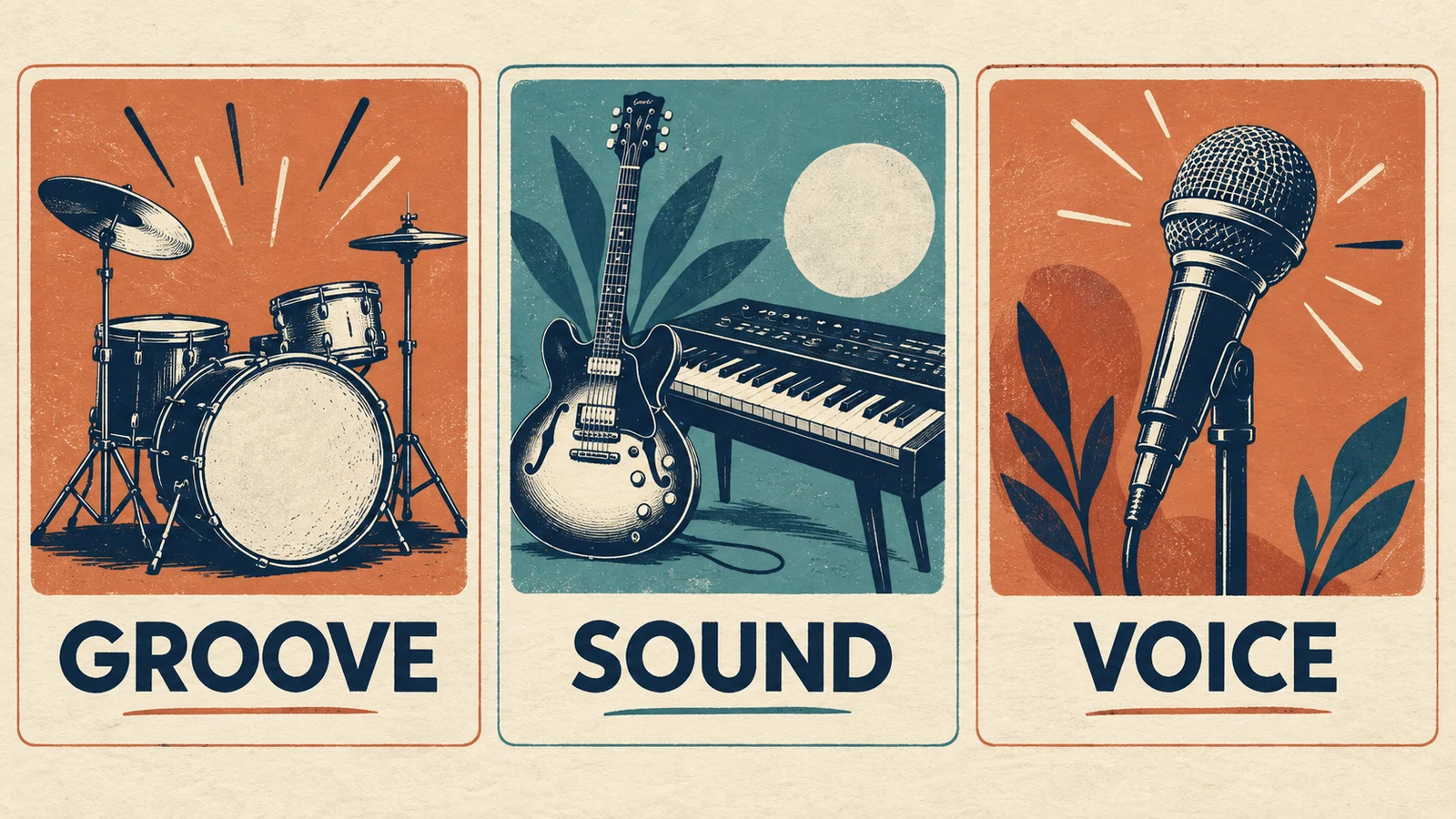
Listen to a reference you enjoy and make a short note in each of these categories:
| Decision | Questions to answer | Useful words for a brief |
|---|---|---|
| Groove | Does it feel steady, loose, driving or spacious? | Relaxed backbeat, steady pulse, sparse percussion |
| Sound | Which instruments lead, and which stay behind? | Muted guitar, warm bass, bright synthesizer, soft piano |
| Voice | How are the words delivered? | Conversational, rhythmic, intimate, restrained, energetic |
Tempo contributes to style, but it does not define it by itself. Ableton's lesson on tempo and genre explains that sounds and patterns also matter. Its examples of typical ranges include 60–100 BPM for hip-hop and 115–130 BPM for house. Those are teaching examples, not rules every track must obey.
If you do not know the tempo, describe the feeling first. “Unhurried, with space between drum hits” gives a collaborator or generator more direction than guessing a number and hoping it fits.
Six genre directions to try in a song brief
The following are deliberately specific arrangements you can explore within broad styles. Each genre contains many other sounds. Use these examples as starting points, then revise the details that do not fit your song.
Pop: give the chorus a clear job
For this pop direction, make the chorus easy to recognize and keep the supporting instruments from competing with it. Decide whether the hook should feel cheerful, wistful or defiant before choosing the production.
Bright synth-pop about reconnecting with an old friend.
A clear lead vocal, warm bass, crisp drums and a short,
memorable chorus. Keep the verse lighter than the chorus.
If the result feels too busy, reduce the layers around the vocal. Adding “catchier” repeatedly does not explain which part of the arrangement needs attention.
Rock: specify the guitar texture and energy
An acoustic-led rock ballad and a distorted guitar track need different instructions. In this example, the guitar provides motion while the vocal stays understandable:
Midtempo guitar rock with crunchy rhythm guitar,
a steady bass line and live-sounding drums.
Direct lead vocal, a tense verse and an open, energetic chorus.
Keep the guitar solo short.
Listen for the relationship between the guitar and singer. If you like the rhythm but cannot follow the words, ask for less guitar density around the vocal rather than replacing the entire style.
Hip-hop: leave room for the delivery
Start this direction with a rhythm and enough space for the words. Specify whether you want rapped verses, a sung hook, or an instrumental beat; those choices affect what you need to write.
Laid-back hip-hop with a dry drum groove, rounded bass
and a sparse keyboard motif. Rhythmic spoken verses about
finishing a long journey, with a brief sung hook.
Keep the backing arrangement uncluttered.
Read the verse aloud against a steady pulse before generating. Shortening a crowded line may help more than asking the music to accommodate every syllable.
Dance and electronic: choose the pulse and the build
“Electronic” leaves many rhythmic possibilities open. For a focused experiment, try a house-oriented brief and describe how its energy should change:
House-inspired instrumental with a steady dance pulse,
warm synthesizer chords and a repeating bass pattern.
Begin with a restrained groove, add percussion gradually,
then return to a simpler ending. No lead vocal.
When reviewing the result, check whether the build suits its purpose. A track for continuous background use may need steadier energy than one intended for a dramatic reveal.
R&B: decide how close the vocal should feel
For this R&B direction, try a soft arrangement around an expressive vocal. Describe the amount of vocal decoration you want, especially if the lyrics need to remain easy to understand.
Warm contemporary R&B with soft electric piano,
deep bass and gentle percussion. Intimate lead vocal
about an honest late-night conversation, with restrained
vocal runs and a spacious chorus.
If the performance feels too elaborate, ask for a simpler melodic delivery. Keep the part you like, such as the piano texture, in the revised brief.
Country: put a concrete scene in the lyric
For this acoustic country direction, build the words around a place, object or action. A porch light or a packed suitcase gives the lyric something specific to return to.
Acoustic country song about finding an old letter
while packing up a childhood home. Fingerpicked guitar,
light percussion and an understated lead vocal.
Let the chorus feel reflective, with a simple arrangement.
The scene does not require an exaggerated accent or a collection of stock phrases. Keep the language natural and let the detail carry the story.
Try the same idea in more than one genre
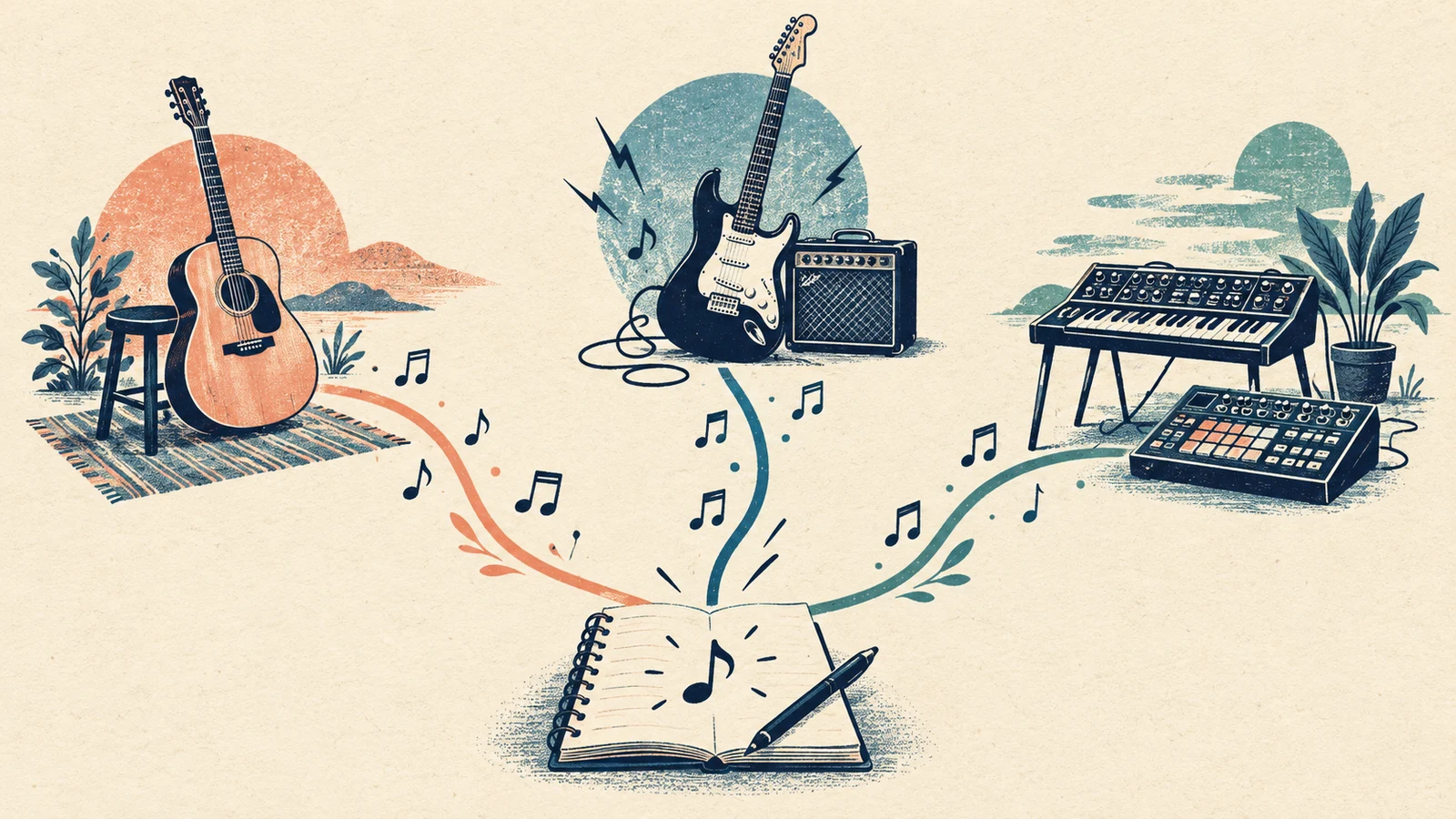
Write one sentence that stays constant: “A song about taking the last train home after making a difficult decision.” Then make two versions of the musical brief, such as understated piano pop and sparse guitar rock.
Keep the story and lyric wording stable where possible. Compare whether the arrangement supports the feeling you intended. A quieter performance may make the story feel unresolved; a fuller chorus may make it feel decisive. Those are choices to evaluate, not reasons to declare one genre universally better.
You can explore the briefs in the AI Music Generator, or use the AI Song Generator when you want to work from lyrics. For the broader sequence from idea to revision, see our guide to making a song with AI.
Change one major direction at a time. If you replace the genre, story, instruments and vocal delivery together, it becomes difficult to identify why one result works better for your project.
Questions about choosing a music style
What is the most popular music genre in the world?
Pop led the favorite-genre list in the IFPI 2023 survey cited above. Always attach the source and year to that answer. A different audience, platform or metric can produce a different ranking.
Can a song belong to more than one genre?
You can combine stylistic directions in a brief. Start with one main direction and name the specific feature you want from another: for example, a pop chorus with an acoustic country arrangement. Avoid a long list of labels with no explanation of how they should work together.
Should I pick a popular genre to get more listeners?
A genre's broad popularity does not establish demand for your particular song. Choose a direction you can describe and evaluate, then consider how it fits the people and setting you are creating for. This guide does not predict audience growth.
Popular music genres are useful vocabulary. Your next useful step is to turn one label into a brief with a clear groove, a few chosen sounds and a vocal direction, then listen for whether those choices serve the song.