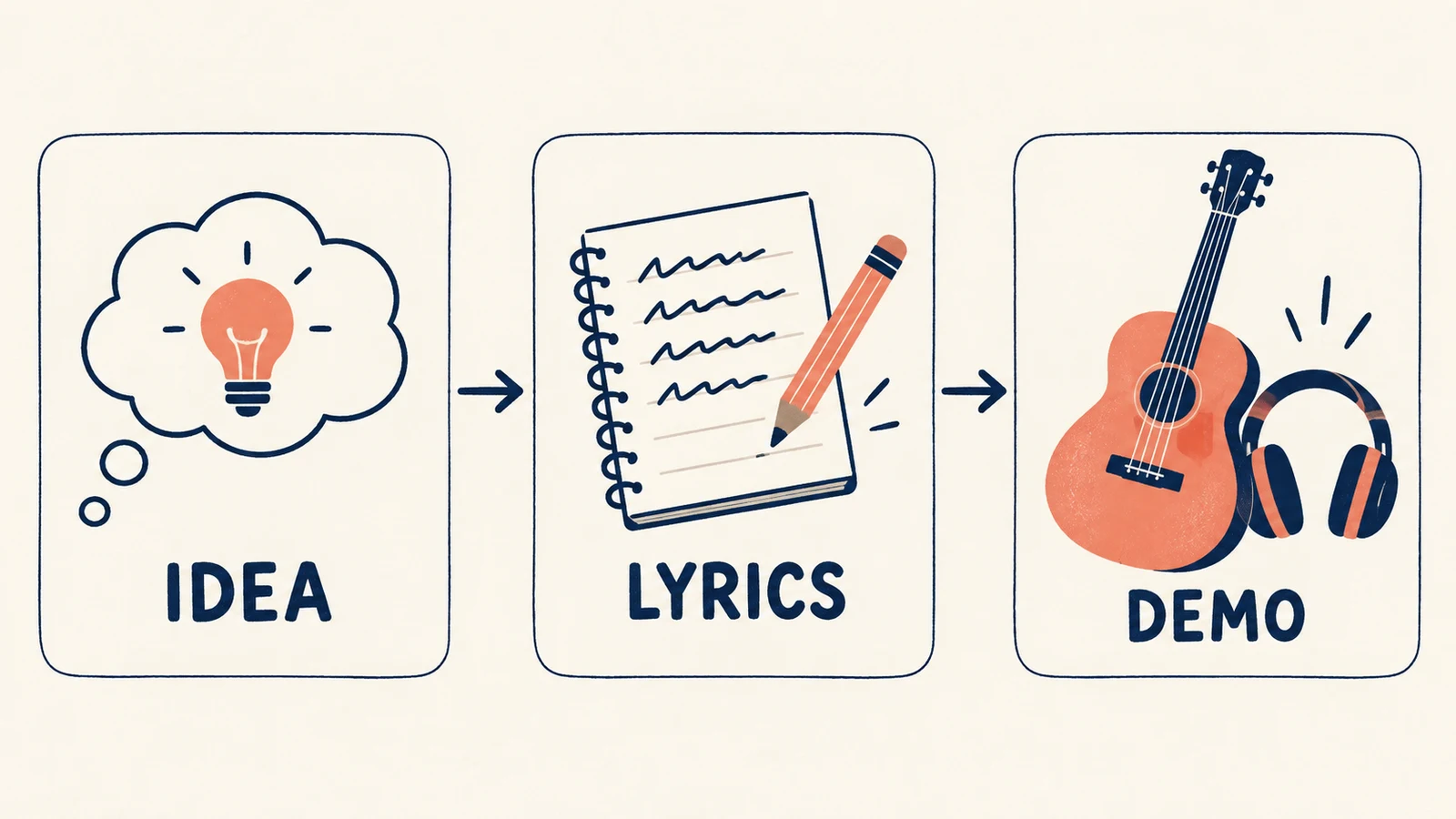
Yes, ChatGPT can help with the written parts of making music: developing a song idea, drafting lyrics, suggesting a structure and discussing musical choices. What you have at that stage is material to work with. A lyric sheet or chord suggestion still needs a performance or production step before you can judge the finished sound.
The useful first question is what you want to leave the conversation with. A chorus, a chord chart and a listenable demo are different deliverables. Ask for one clearly rather than expecting “write me a song” to settle all three.
What can ChatGPT contribute to a song?
OpenAI describes ChatGPT's core capabilities as including drafting, rewriting, explanation and creative suggestions. Applied to songwriting, those capabilities give you several possible tasks:
| Task | Ask for | Check yourself |
|---|---|---|
| Develop an idea | A few distinct situations or points of view | Whether the story means something to you |
| Draft lyrics | One section with clear constraints | Natural language, rhythm and singability |
| Shape the structure | A proposed sequence of sections | Whether the song develops instead of repeating itself |
| Discuss harmony | A clearly labelled chord suggestion | How the chords sound when played |
| Prepare production | A brief covering style, instruments and vocals | Whether a performer or generator can act on it |
The workflow below focuses on text you can inspect and revise. Available tools differ by account and settings, so do not assume that a feature shown in somebody else's conversation will be available in yours. Nor does a spoken response automatically amount to a produced song: OpenAI's Voice documentation describes conversational speech, which is a different deliverable from the demo you are planning here.
Start with one scene, not a list of emotions
“Write a moving song about change” gives you little to evaluate. Try a situation that contains objects, actions and a point of view:
Help me develop an original song about closing a small bookshop
for the last time. The narrator is the owner.
The feeling is affectionate and unresolved, not triumphant.
Give me three possible central images. Do not write lyrics yet.
Avoid storms, broken wings and other stock metaphors.
Choose the image that suggests a real scene. A key, an empty shelf or a mark left by a sign can each lead to a different song. You do not need to use every suggestion.
Then decide what changes between the beginning and ending. Perhaps the owner begins by counting the remaining books and ends by leaving one for the next tenant. That gives the lyric an action to follow, instead of asking each verse to explain the same feeling in different words.
These prompts and the lyric below are original editorial examples. They are not presented as results from a recorded test or as a guarantee of what a particular model will return.
Ask for a small lyric section first
Give ChatGPT one section to work on, then revise it before expanding the song:
Write a four-line chorus for the bookshop scene.
Use everyday language and one concrete image.
The hook should be about leaving a light for the next person.
Keep the lines short enough to try aloud at an unhurried pace.
Do not name an existing song or imitate a named artist.
Here is one possible chorus written for this guide:
Leave one light above the door
For a name I do not know
All the stories I kept here
Have another place to go
Read it aloud. The image is understandable, but you might want the last line to feel more uncertain. That is a specific revision request:
Keep the first three lines exactly as written.
Offer five alternatives for the final line.
Make the ending less certain without adding a new metaphor.
Explain briefly how each alternative changes the meaning.
The instruction to preserve three lines matters. Without a clear boundary, a revision can replace the detail you liked along with the line you wanted to change.
Revise for a voice, not just for the page
Text that reads smoothly can still feel crowded when sung. Try the words against a steady pulse or a simple melody. Mark the places where you run out of breath, rush a syllable or stress a word oddly.
You can ask for help identifying those spots:
Review this chorus for words that may feel crowded or unnatural
when sung slowly. Suggest shorter alternatives only where needed.
Keep the story and hook intact. Treat your rhythm suggestions
as possibilities for me to audition, not as a verified melody.
Check any syllable counts yourself, particularly names, contractions and words with more than one pronunciation. A confident explanation is not a substitute for trying the line in your own voice.
OpenAI's writing-block guide explains how supported drafts can be edited and revised within a conversation. If your account offers those controls, they can help you keep one working lyric. A plain text document works too. Save the version you prefer before asking for a larger rewrite.
Give chord and melody suggestions an audition
If you want harmonic ideas, specify an output you can actually use. For example:
Suggest two simple chord progressions to audition under this chorus.
Label the key and give one chord per bar in 4/4.
Use plain chord names, explain the intended contrast,
and state any assumptions. Do not claim you have heard the result.
Play the suggestions on an instrument or enter them into a music tool. Compare them under the same lyric so you can hear the difference. If you do not play, ask a collaborator to help rather than treating a written explanation as proof that the progression fits your vocal line.
For a melody sketch, request explicit notes, durations and a stated range instead of “a beautiful melody.” Those details make the proposal inspectable. They still need playback and revision: a list of notes cannot tell you everything about phrasing, breath or delivery.
Turn the approved lyric into a music brief
Once the words are stable enough to try, separate them from the arrangement instructions. A brief for the bookshop song might read:
Understated acoustic folk-pop. Fingerpicked guitar,
soft piano and a restrained lead vocal.
Begin quietly and let the chorus open slightly without a large build.
Keep the words clear and leave space between phrases.
The mood is affectionate, with an unresolved ending.
You can take that brief to a musician, build a demo in your own recording software, or explore a version with the AI Song Generator. If you only need help shaping the words, the AI Lyrics Generator provides another place to develop the draft. Neither step is an automatic connection to ChatGPT; transfer the text and review the output yourself.
Listen for whether the arrangement preserves the story. An energetic chorus might sound polished while contradicting the quiet ending you wanted. Keep a note of what works and change the brief in one direction at a time. Our AI songwriting workflow covers reviewing the wider draft.
Common questions
Can ChatGPT write a complete song in one prompt?
It can help draft a complete lyric and written plan. Whether that first draft is useful depends on the constraints and your review. Working section by section makes it easier to preserve a strong hook and identify weak lines.
Can ChatGPT give me a finished recording?
Do not infer that from receiving lyrics, notation or a spoken answer. Check the actual output and any tools available in your conversation. In this workflow, producing and listening to the demo is a separate step.
Should I accept the first rhyme or chord suggestion?
No. Compare it with the meaning and sound you want. A tidy rhyme can weaken a specific image, and a plausible chord sequence may not suit the melody you sing. Keep the option that serves the song after trying it.
So, can ChatGPT write music? It can contribute useful written ideas and revisions. Give it a bounded task, preserve your strongest decisions, and move from reading to listening before deciding that the song is finished.